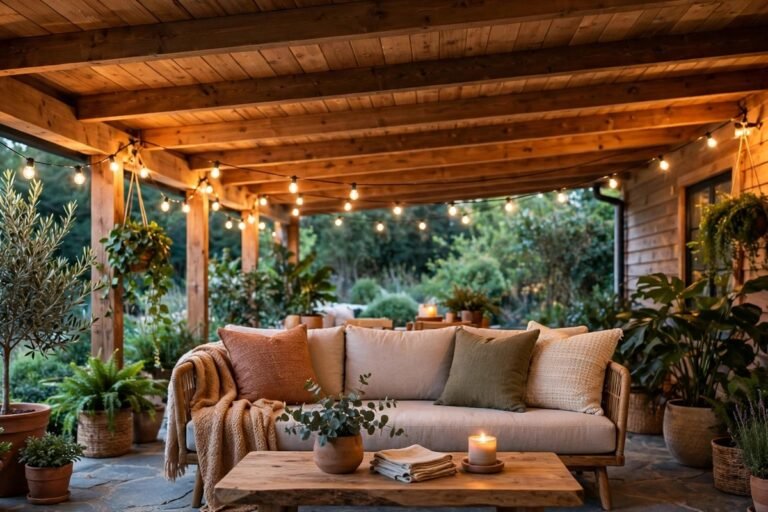
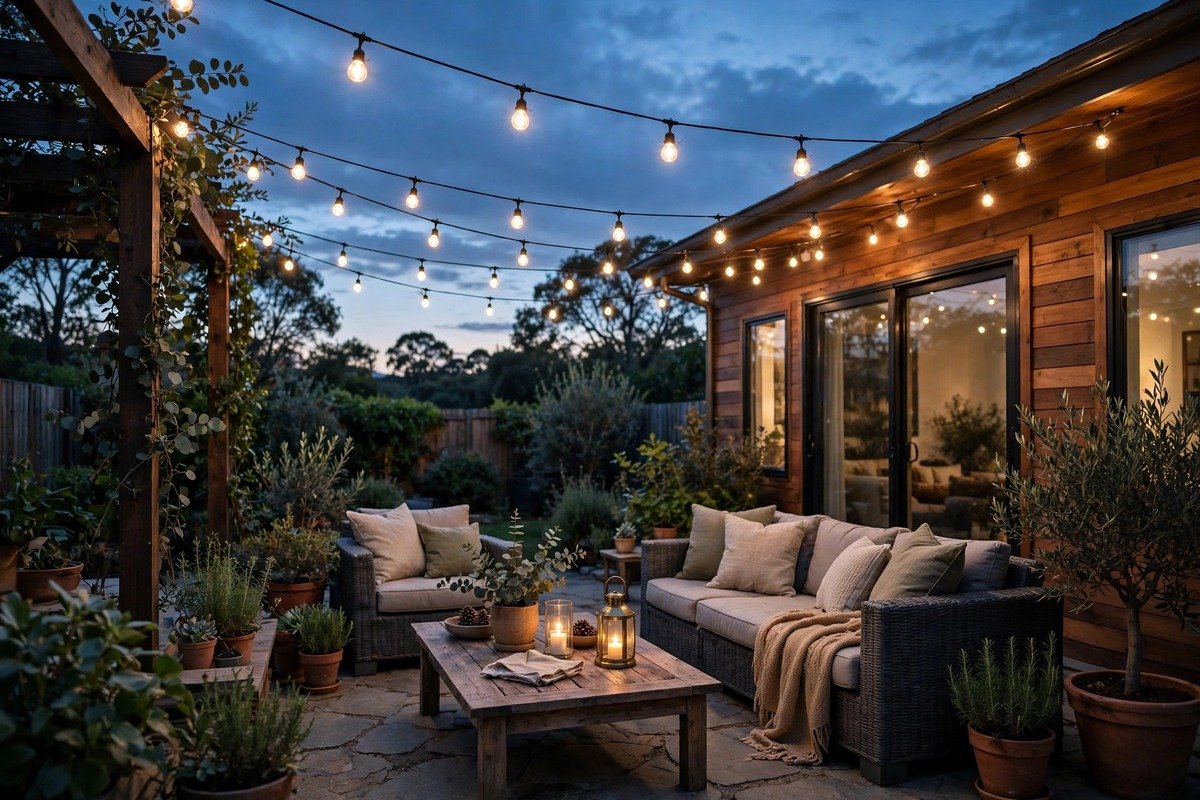
String lights are one of the cheapest ways to make an evening outside feel good. One strand over a table can be enough for a quiet dinner. A full set of strands over a patio can make the same space feel ready for guests.
This guide gives you 25 outdoor string light ideas that focus on the lights themselves. You will find ways to hang them, ways to power them, and bulb styles that change the look. Pick one idea that fits your space and your budget, and start there.
Quick Picks
- Start with warm white bulbs. Bulbs near 2700K look soft at night and suit most patios.
- Buy outdoor rated strands. Look for IP65 or higher so rain does not ruin the sockets.
- Hang lights 8 to 10 feet high. That height clears heads and keeps the glow close.
- Measure before you buy. Add about one third extra length for droop and curves.
- Use a GFCI outlet for plug in lights. It is the safe choice for any outdoor power.
Did You Know?
LED string lights use very little power. A 50 foot LED strand can draw about 15 to 25 watts, so running it for eight hours a night may add only about 1 to 2 dollars a month to a power bill. Old incandescent strands can use five times as much.
Before You Start
- Walk the space at night and mark where you sit, eat, and walk.
- Find the nearest outdoor outlet and check if it has test and reset buttons.
- Check the box for the maximum number of strands you can link end to end.
- Pick one main bulb color for the whole yard so the light looks planned.
- Keep lights away from grills, open flames, and low tree branches that can catch.
Overhead Patterns
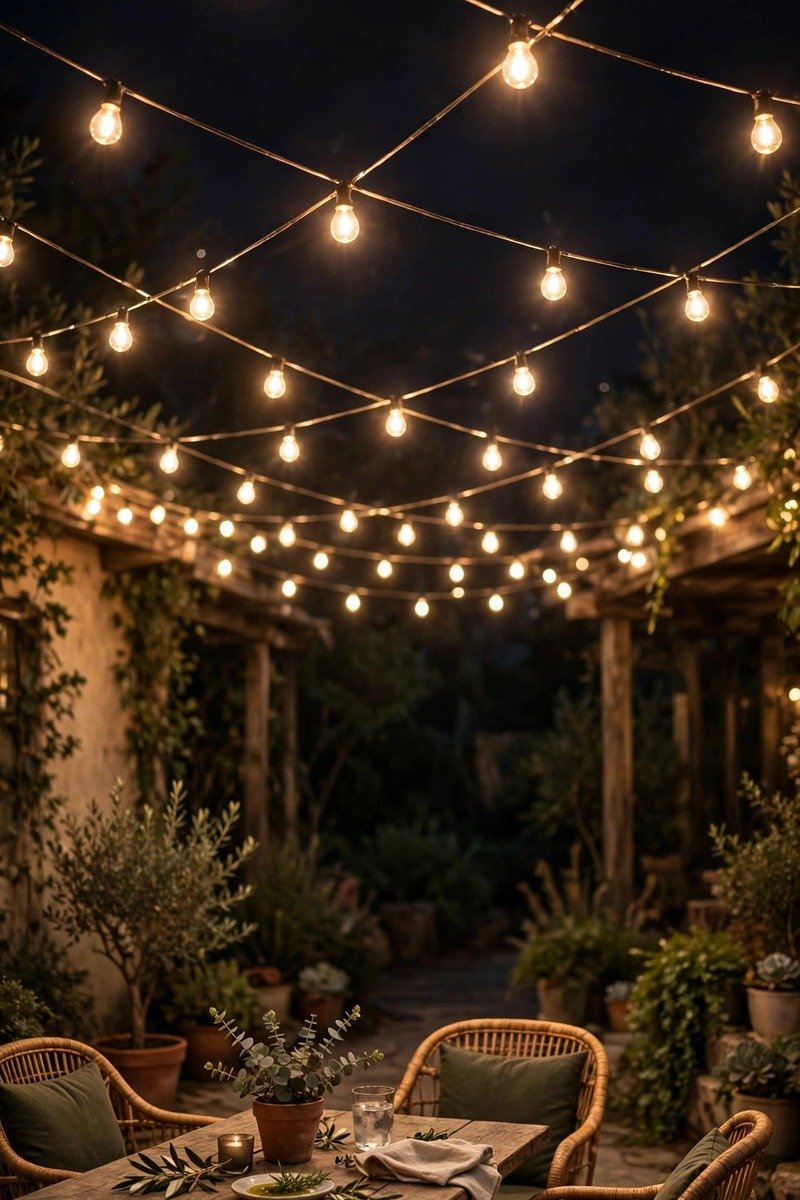
1. Crisscross Canopy Over a Patio
A crisscross canopy is the classic cafe look. Strands cross over the seating area in both directions, so light falls evenly and no chair sits in a dark spot.
Pro tip: For a 12 by 12 foot patio, plan 100 to 130 feet of lights. Use four to six strands and hang them 8 to 10 feet high.
2. Parallel Runs Along Pergola Beams
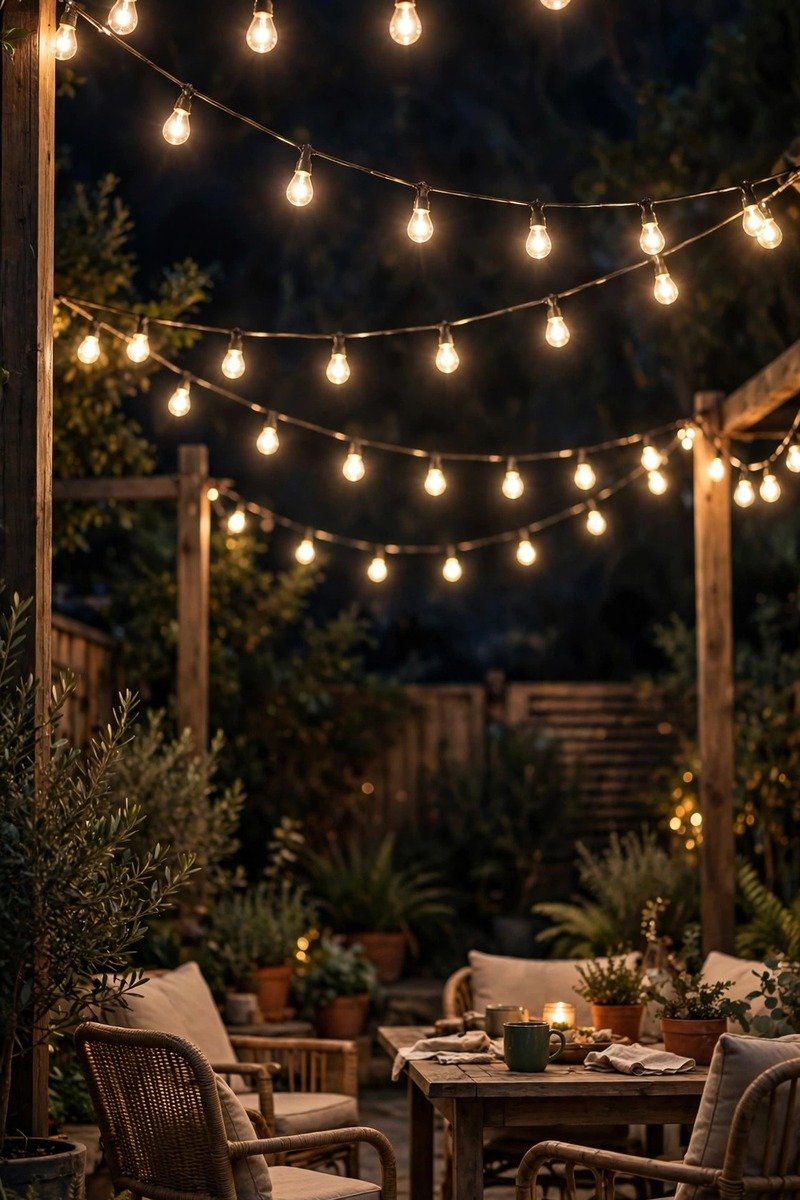
Parallel runs are simple and neat. Each strand follows one beam, so the pattern looks clean and the light stays even over a long table or bench.
Pro tip: Space strands about 2 feet apart. Clip each strand to the beam every 3 feet so wind does not pull it loose.

3. Cafe Zigzag Between Posts
A zigzag pattern covers a wide patio with fewer strands than a full grid. The lights run back and forth between two rows of posts, which keeps the middle open and bright.
Pro tip: Set posts 10 to 12 feet apart. Leave a gentle droop of 6 to 12 inches between posts so the line does not look tight.
4. Guide Wire Over an Open Patio
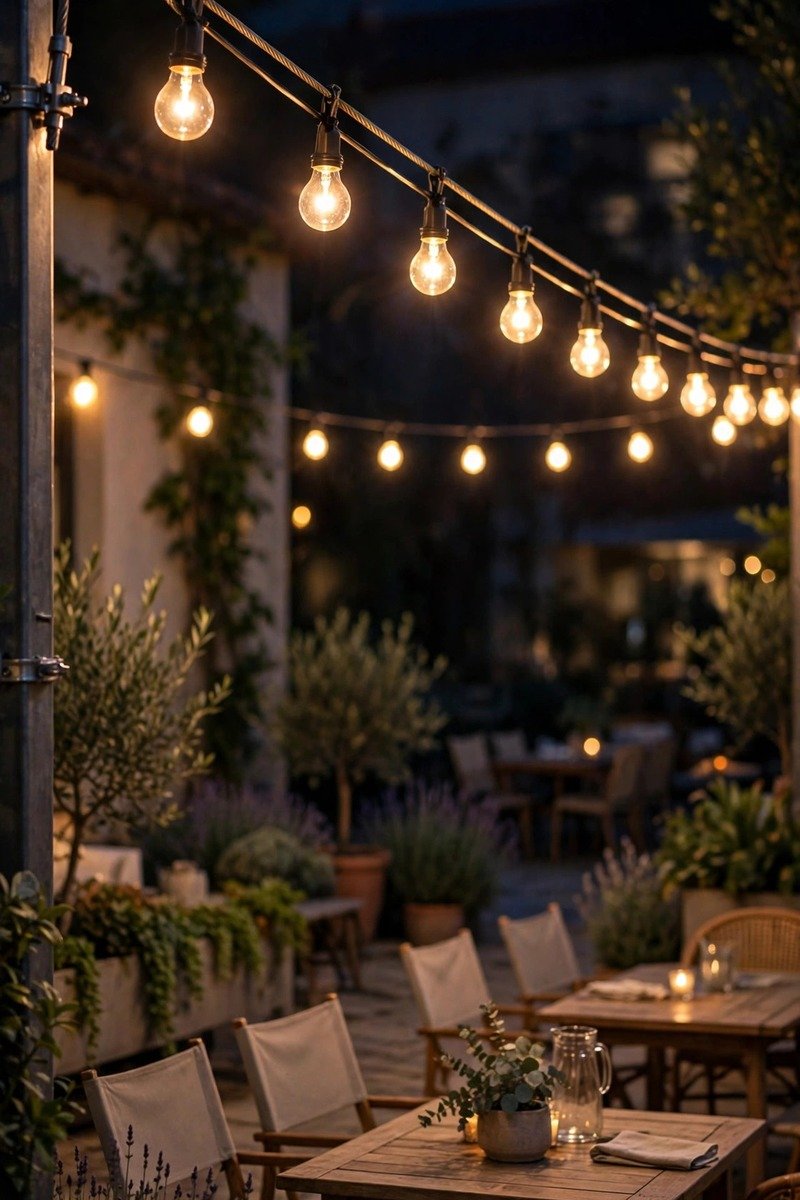
A steel guide wire holds the weight on long spans. The wire goes up first, then the light strand clips to it, so the bulbs do not sag or strain the wire inside the strand.
Pro tip: Use a turnbuckle at one end to pull the wire tight. For spans over 20 feet, a guide wire is worth the extra cost.
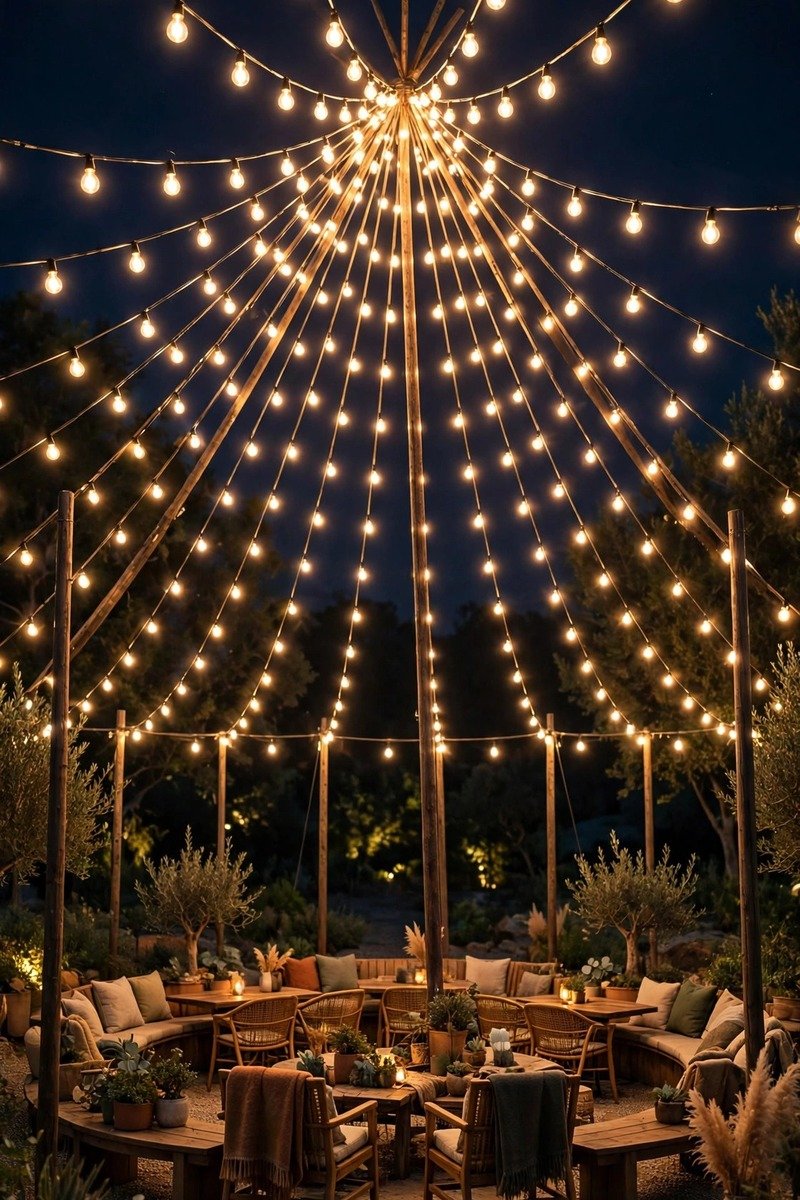
5. Teepee Poles to a Center Point
Four or five poles in a circle can make a roof of light with no house wall needed. Each strand runs from a pole top to one shared center point, like a tent frame.
Pro tip: Anchor each pole base with a heavy pot or a ground stake. Wind load on long strands is higher than most people expect.
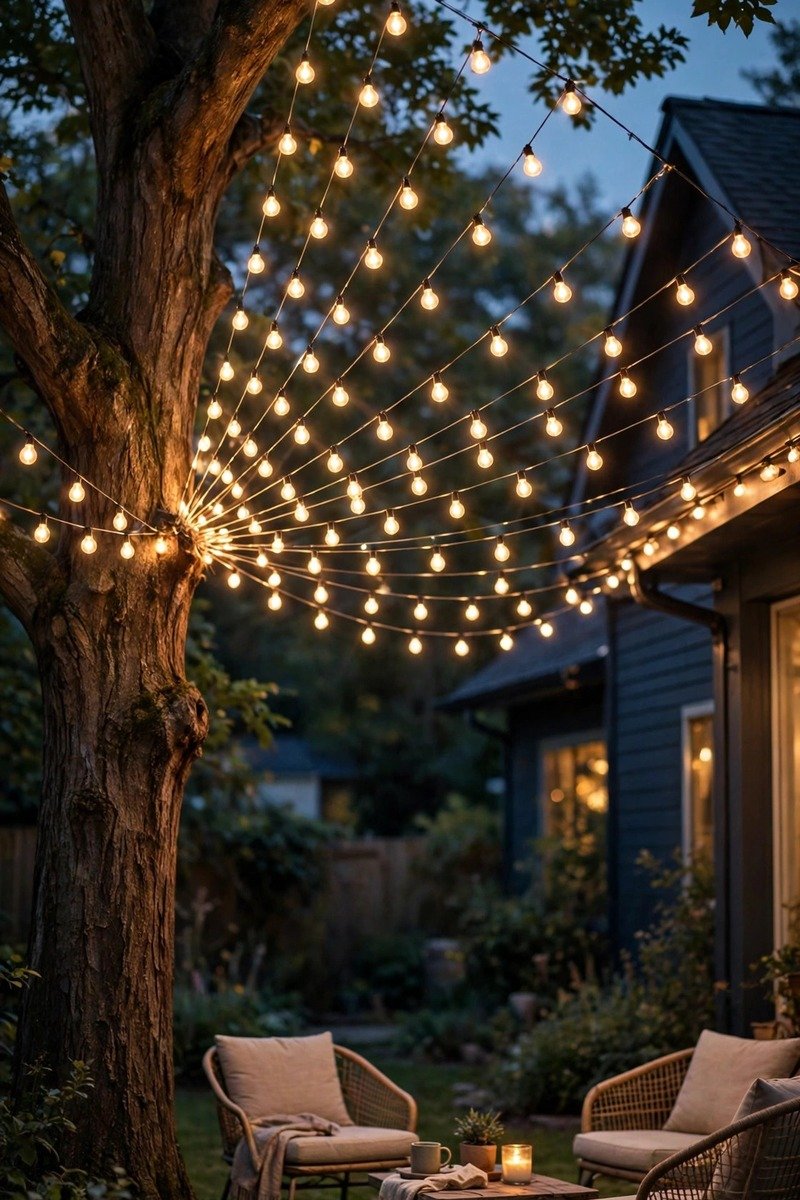
6. Fan Canopy From a Tree to the House
A strong tree can be the main anchor for a wide fan of lights. Strands spread from the trunk to the house roofline and cover a lawn seating area with no extra posts.
Pro tip: Use wide tree straps, not nails, on the trunk. Check the straps once a season so the tree can grow without damage.
Frames, Posts and Covers
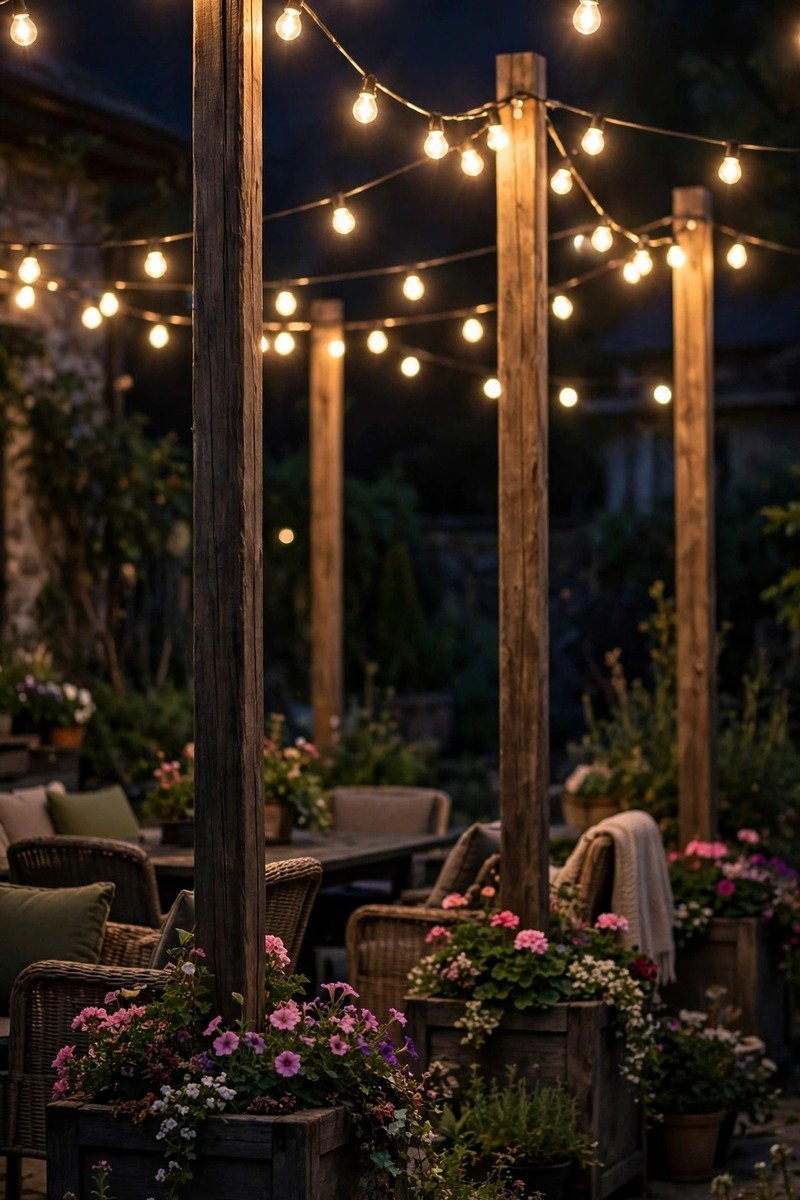
7. Planter Post Frame
Posts set in large planters give you a light frame you can move. This suits renters and open patios, and the planters can hold flowers at the base for a finished look.
Pro tip: Use a 10 foot post in a pot at least 18 inches wide. Fill the base with concrete or heavy gravel so the post stays upright.
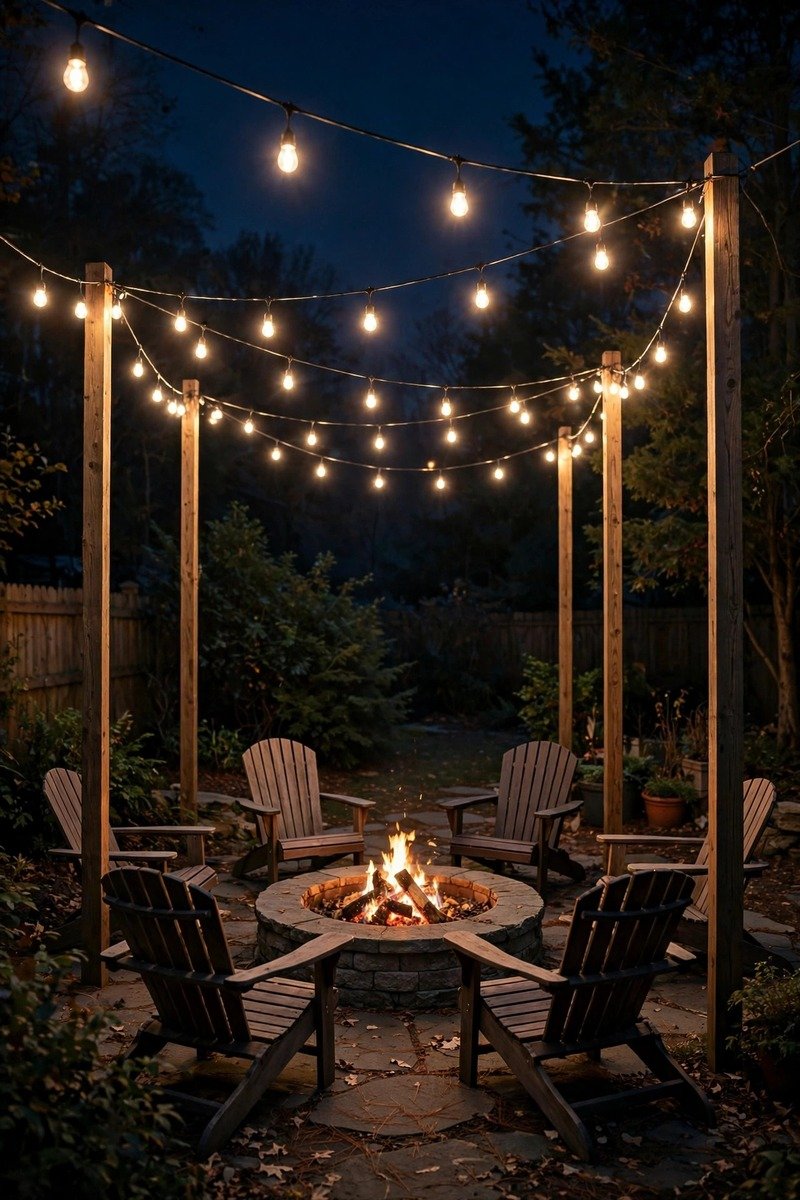
8. Post Frame Around a Fire Pit
Four posts around a fire pit mark a clear gathering spot after dark. The lights stay high, so heat and sparks stay clear of the bulbs, and chairs get even light. For the seating side of this setup, see our outdoor fire pit ideas.
Pro tip: Keep posts at least 6 feet from the fire pit edge. Hang lights 9 feet high so no one walks into a hot bulb.
9. Umbrella Cascade
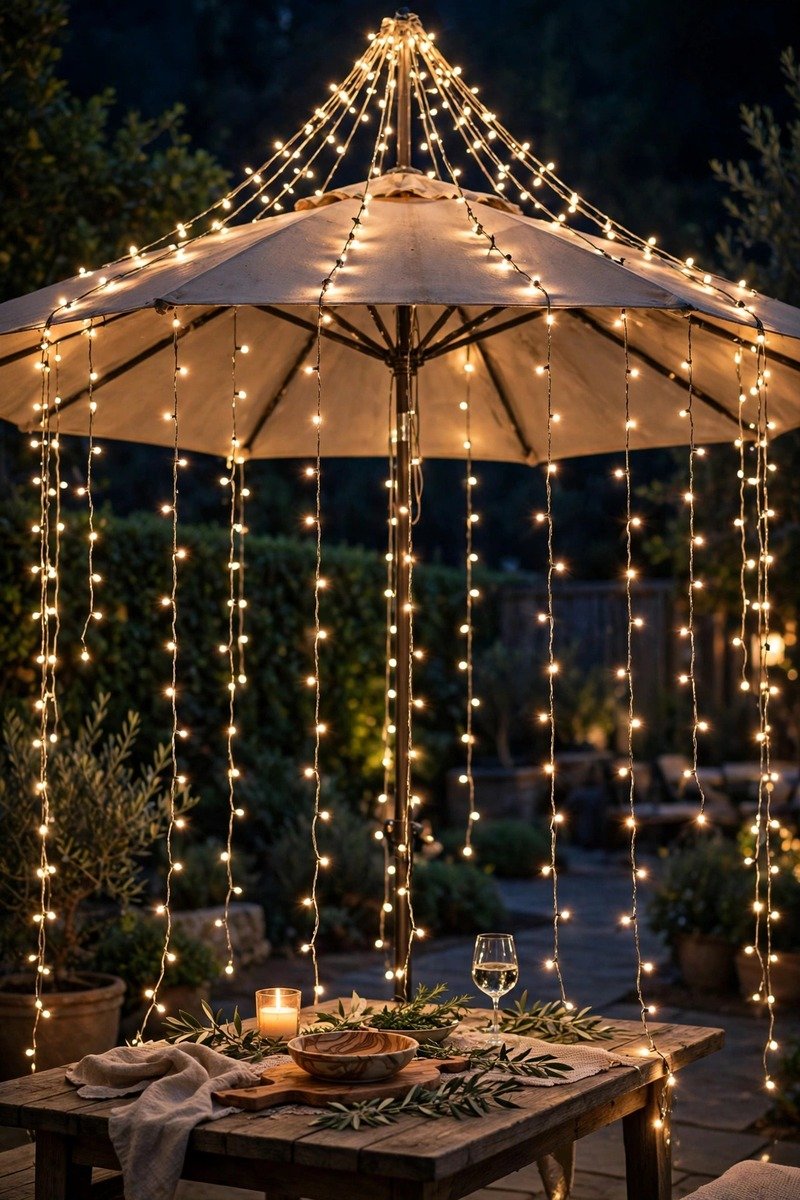
One patio umbrella can carry a full set of lights. Strands run from the top of the open umbrella down to its edge, which makes a soft tent of light over one table.
Pro tip: Use light clips made for umbrella ribs. A 25 foot strand is enough for most 9 foot umbrellas.
10. Lights Over a Shade Sail
A shade sail gives daytime shade, and lights over it give evening glow. Strands run across the top of the sail or along its edges, so the sail becomes the ceiling for the night.
Pro tip: Attach lights to the sail posts, not to the fabric alone. Fabric stretches in rain and can pull loose clips down.

11. Covered Porch Roofline
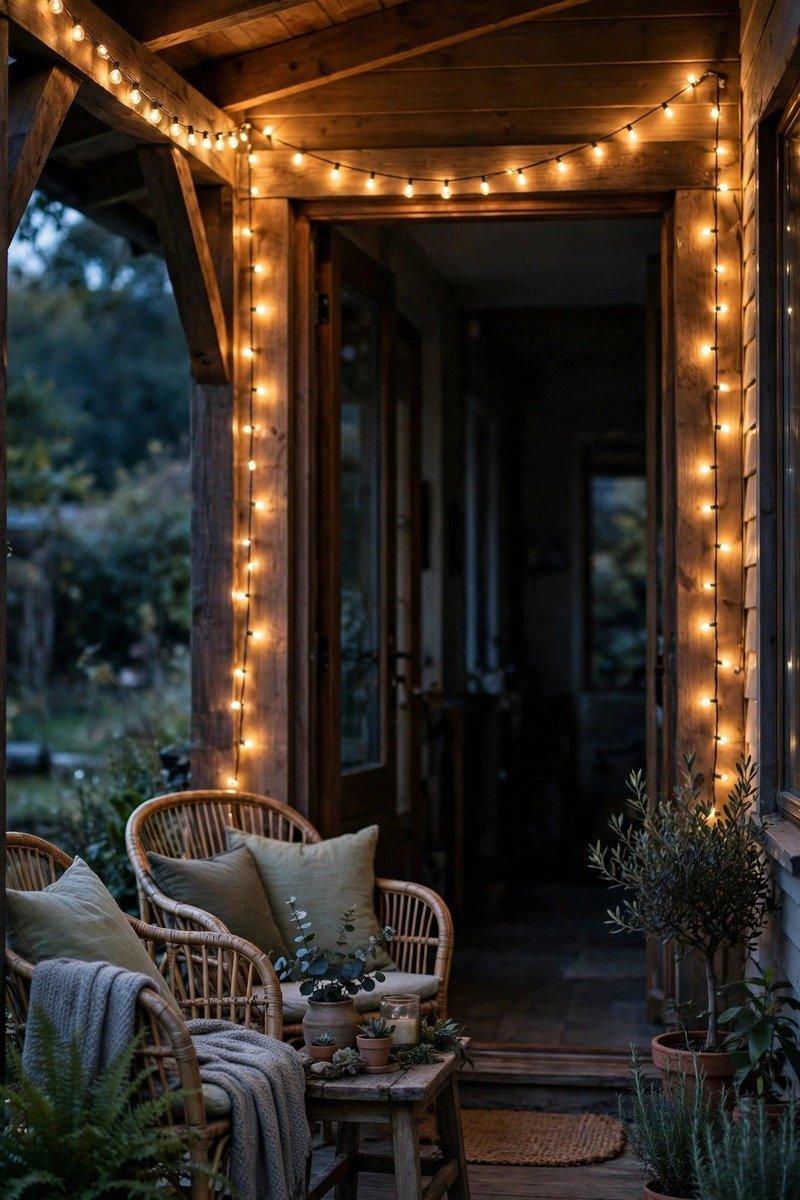
A single strand along a porch roofline frames the whole entry. It is a small job, but it makes the porch easy to find at night and pleasant to sit on. For full porch setups, see our outdoor patio ideas.
Pro tip: Use clips that fit your roof edge or siding seam. Avoid nails in wood trim, since nail holes let water in over time.
Trees, Arbors and Walls
12. Tree Trunk Spiral
A spiral up a tree trunk turns a plain tree into a light feature. The wrap starts low and climbs to about 8 feet, which lights the base of the tree without hiding the branches.
Pro tip: Use a 50 foot strand for a medium trunk. Wrap with gaps of about 4 inches so the bark still shows between lights.

13. Hanging Branch Clusters
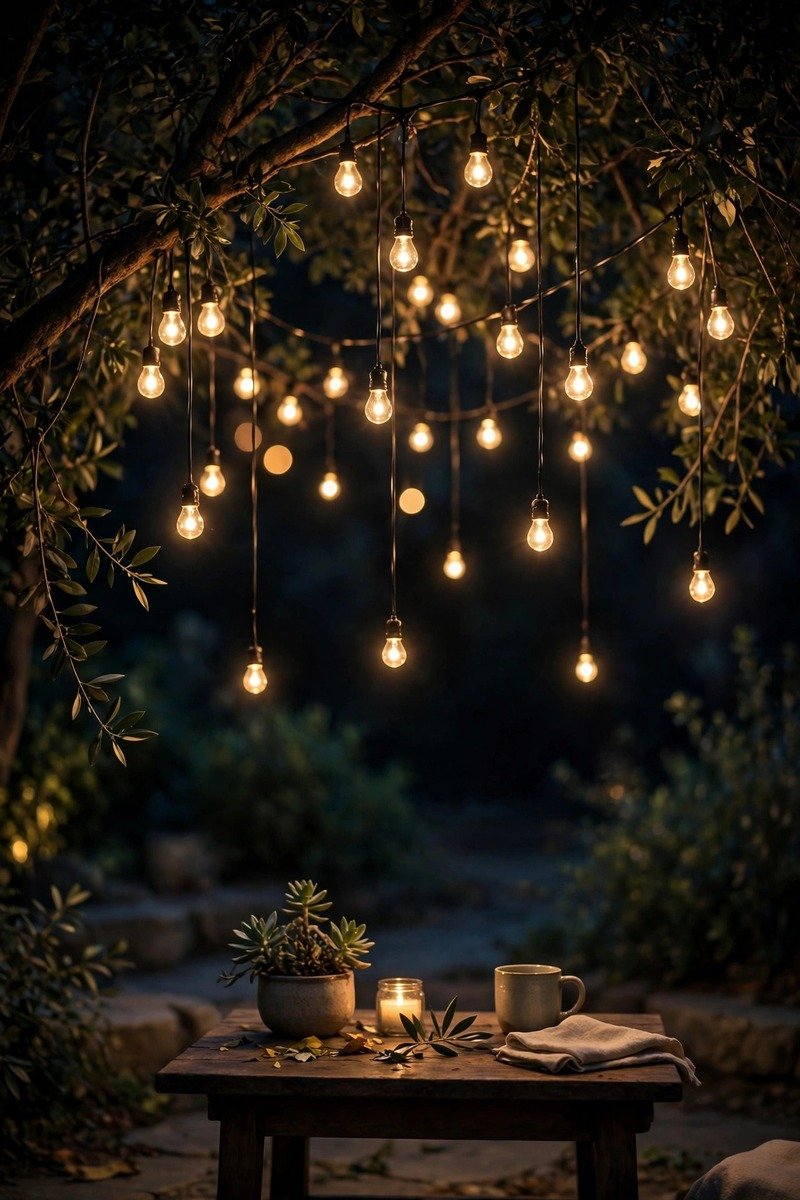
Short clusters hung from branches look like drops of light in the canopy. They work well over a reading chair or a small table, where a full overhead grid would be too much.
Pro tip: Hang clusters at different lengths, from 2 to 4 feet. Keep them clear of walkways so no one brushes a low bulb.
14. Arbor Tunnel of Fairy Lights
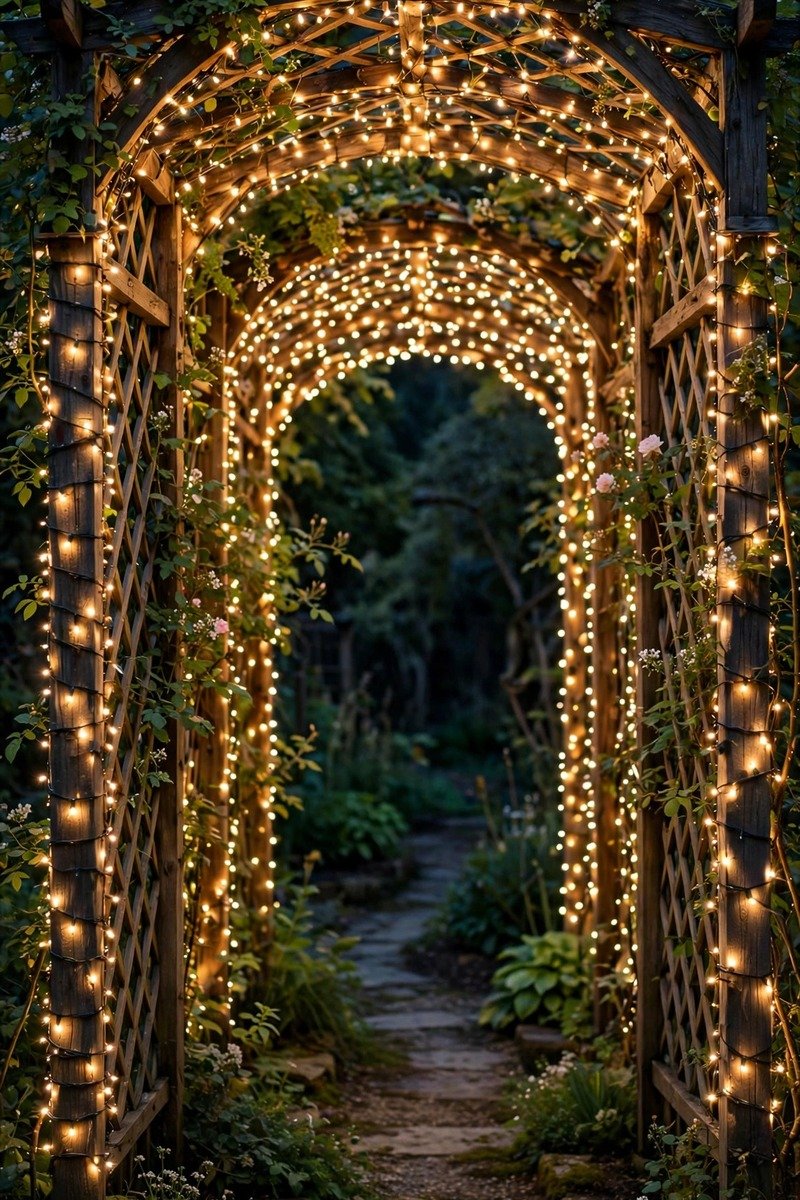
An arbor wrapped in fairy lights becomes a glowing path. Dense small bulbs on the posts and top frame light the walkway and show off climbing plants at the same time.
Pro tip: Use two 33 foot fairy strands for a standard 8 foot arbor. Wrap the posts first, then the top, so the ends meet at the back.
15. Vertical Fairy Curtain on a Trellis
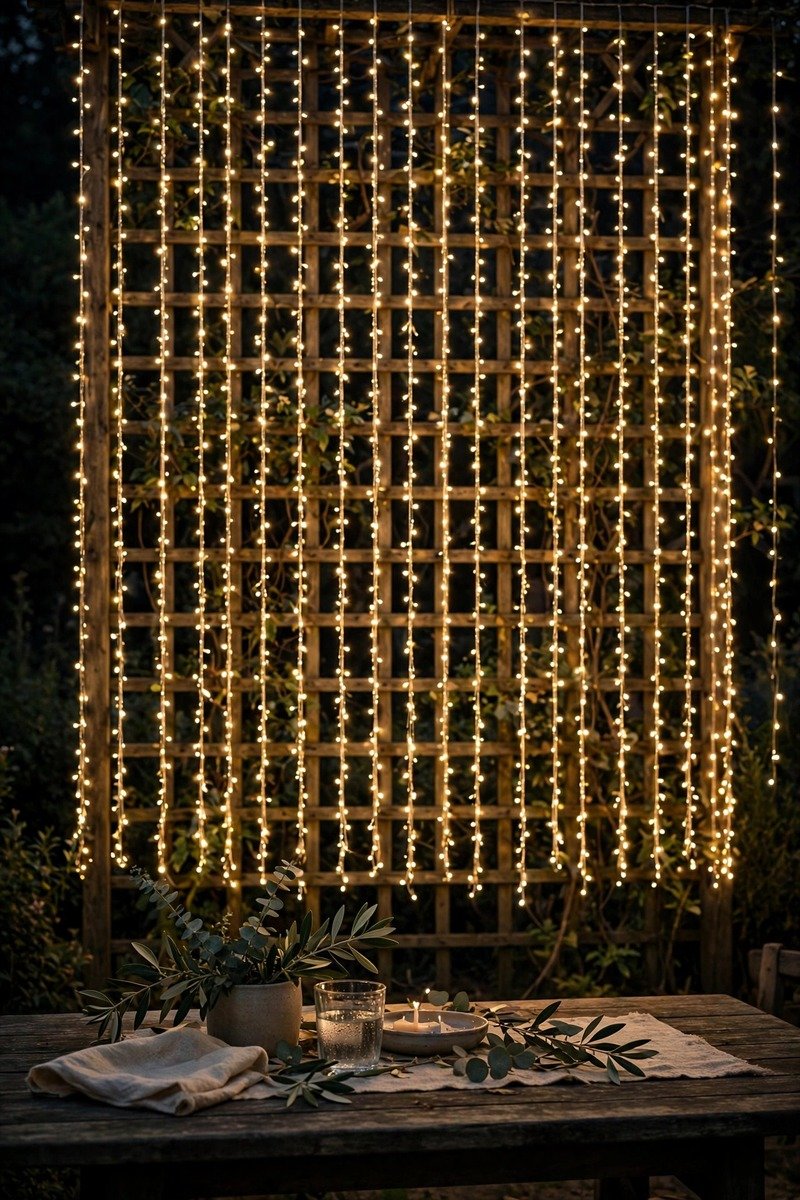
Vertical strands hung from a trellis make a wall of light behind a table. It works as a backdrop for dinners and photos, and it hides a plain fence after dark.
Pro tip: Hang strands 4 inches apart for a full curtain look. A 10 foot wide trellis needs about 30 vertical drops.
Bulb Styles That Set the Mood
16. Edison Festoon Bulbs
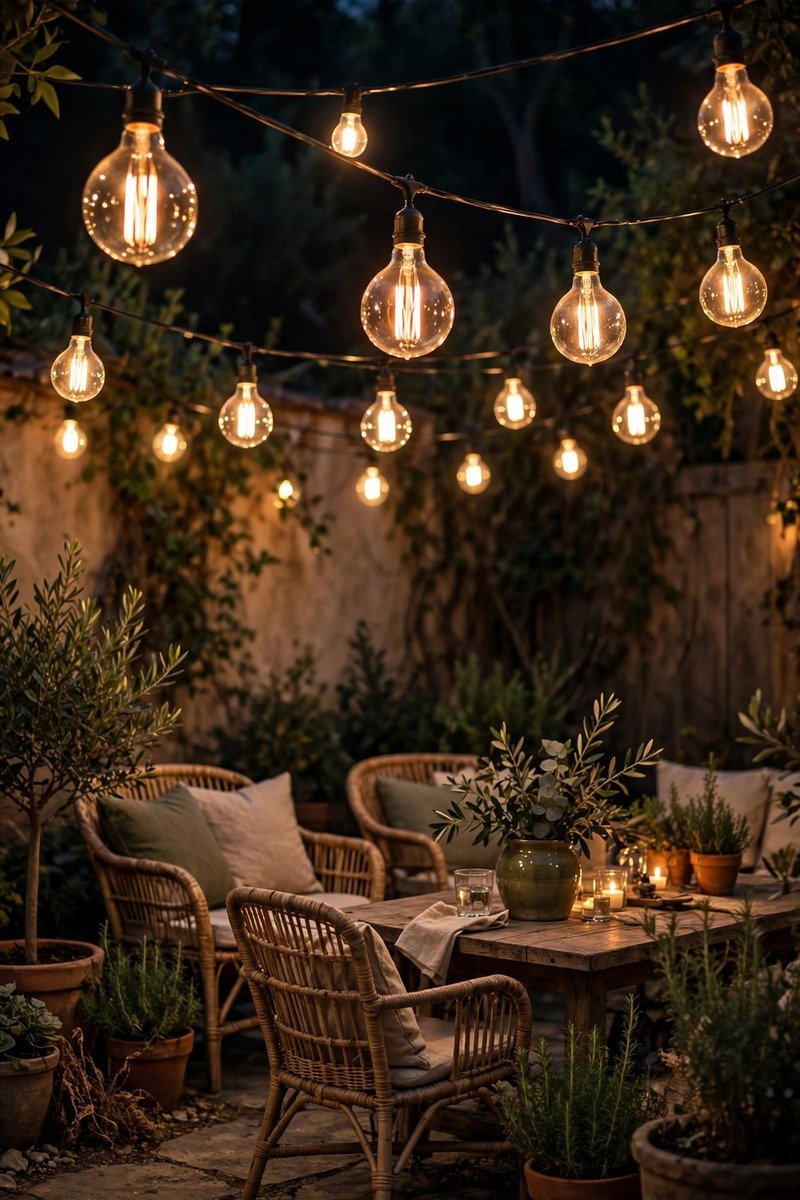
Edison style bulbs have a visible warm filament and a vintage cafe feel. Their larger size makes them easy to see, which suits overhead grids where the bulbs are part of the look.
Pro tip: A 25 foot commercial strand costs about 35 to 70 dollars. Pick shatterproof plastic bulbs if kids or hail are a concern.
17. Round Globe Bulbs
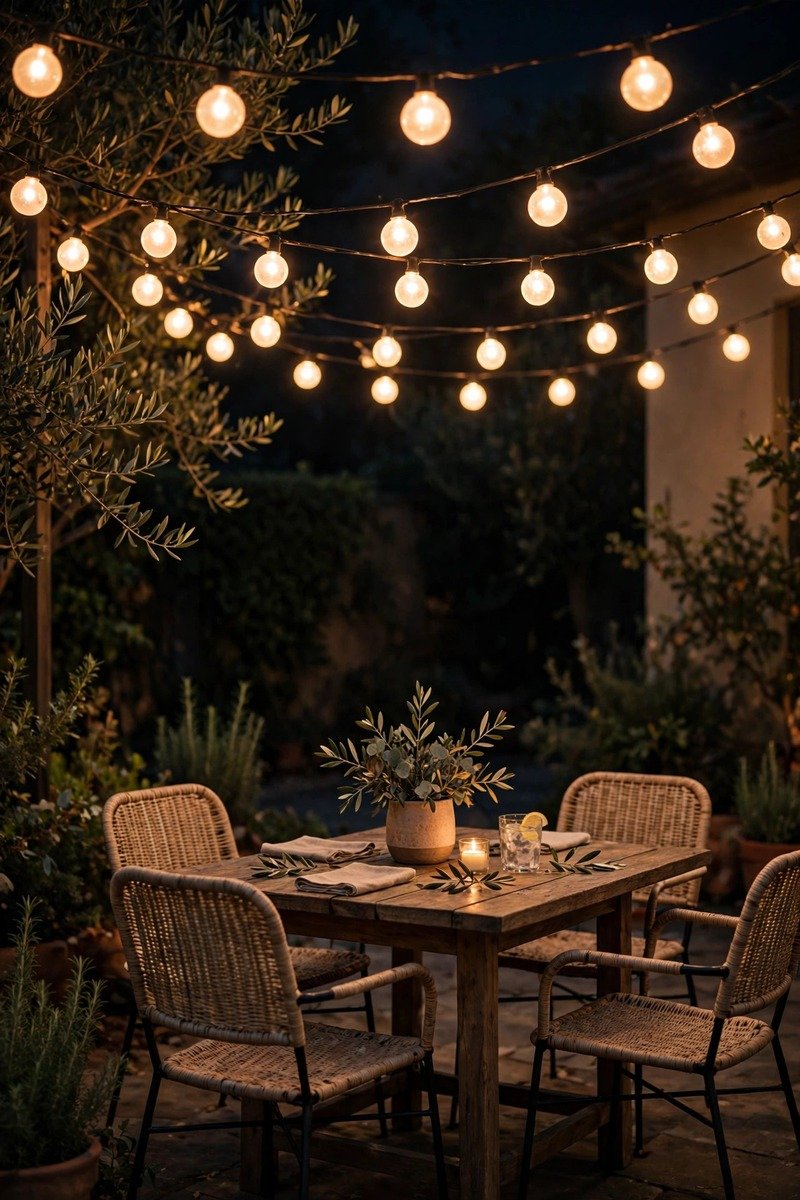
Round globe bulbs give a softer, more even glow than clear Edison bulbs. Frosted globes spread light in all directions, so they suit modern patios and large canopies.
Pro tip: A 25 foot globe strand costs about 40 to 90 dollars. Use 2700K to 3000K for a warm look, not cool white.
18. Micro LED Fairy Lights in Plants
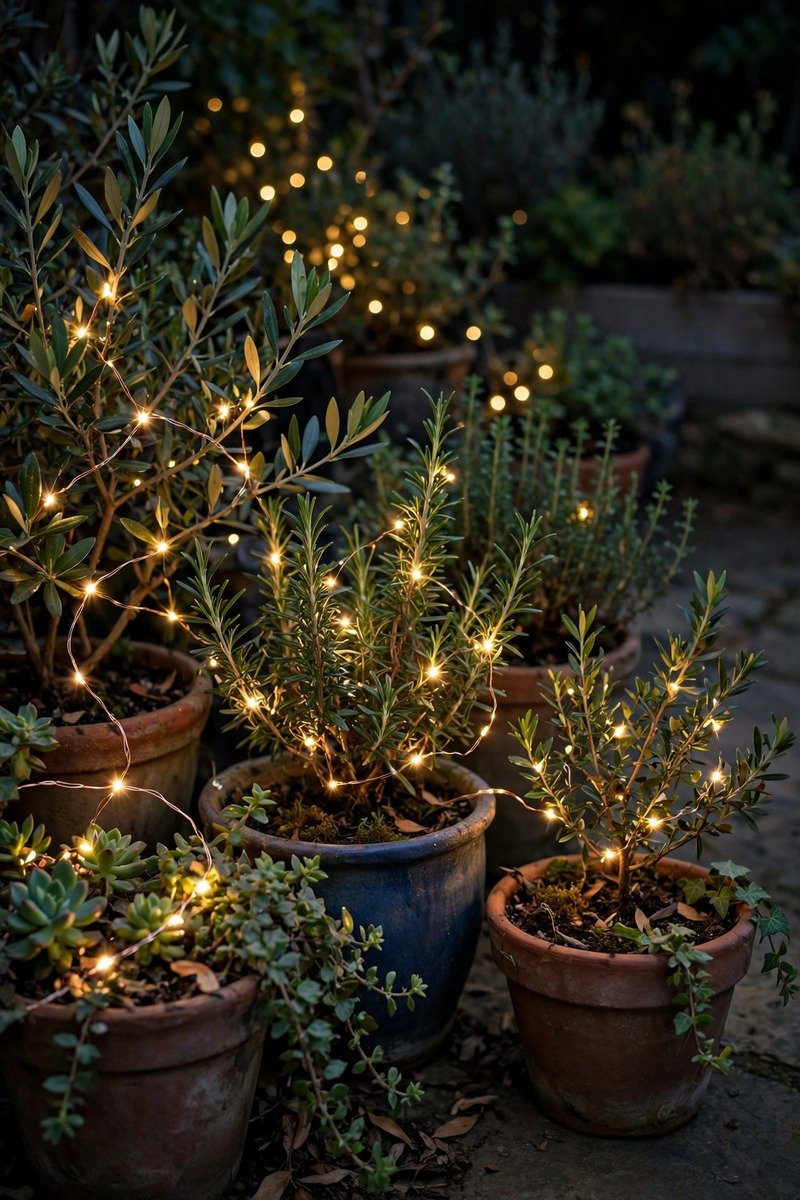
Thin fairy strands with tiny LEDs are best as an accent, not the main light. Tucked into pots, shrubs, or a railing, they add sparkle without glare.
Pro tip: Look for strands with 100 or more lights per strand. A 33 foot strand costs about 10 to 20 dollars.
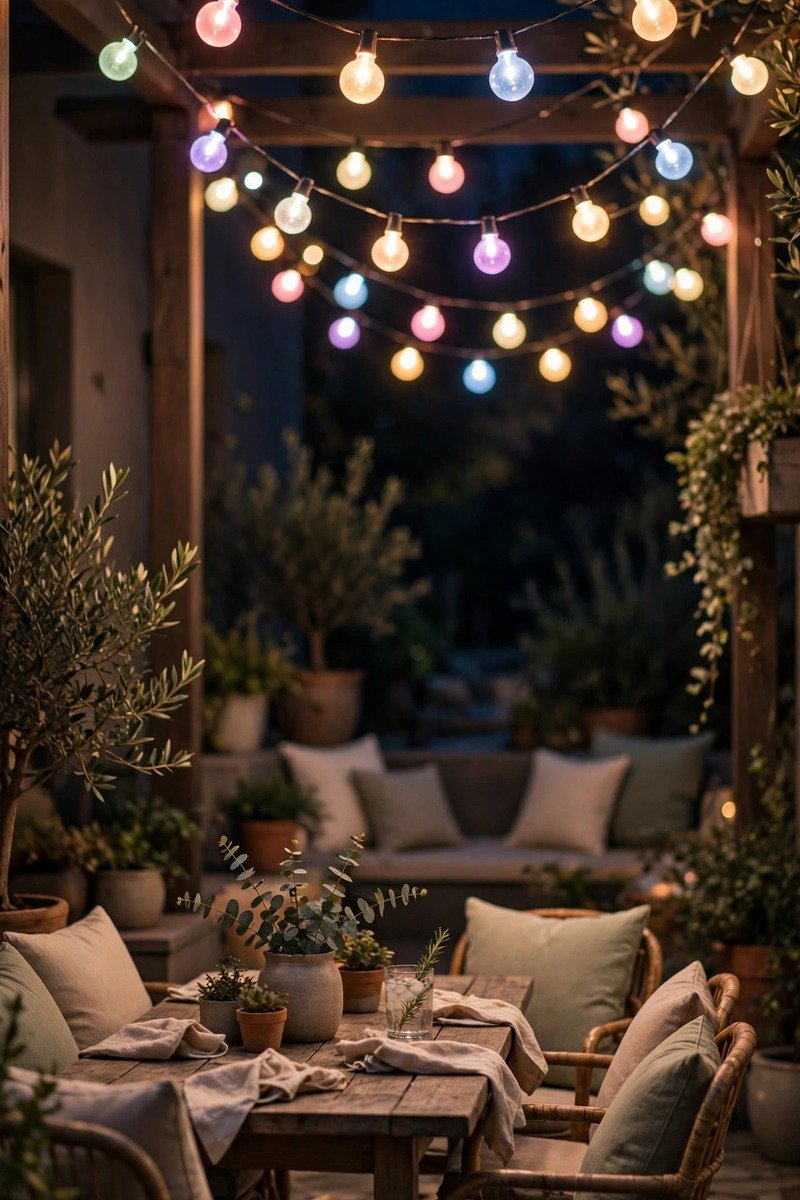
19. Color Changing Smart Strings
Smart strings let you change color and brightness from a phone. Warm white suits most nights, while a soft color can mark a party or a holiday without a new set of lights.
Pro tip: Set a timer in the app for dusk to 11 pm. That saves power and keeps the lights from running all night.
20. Paper Lantern Strings
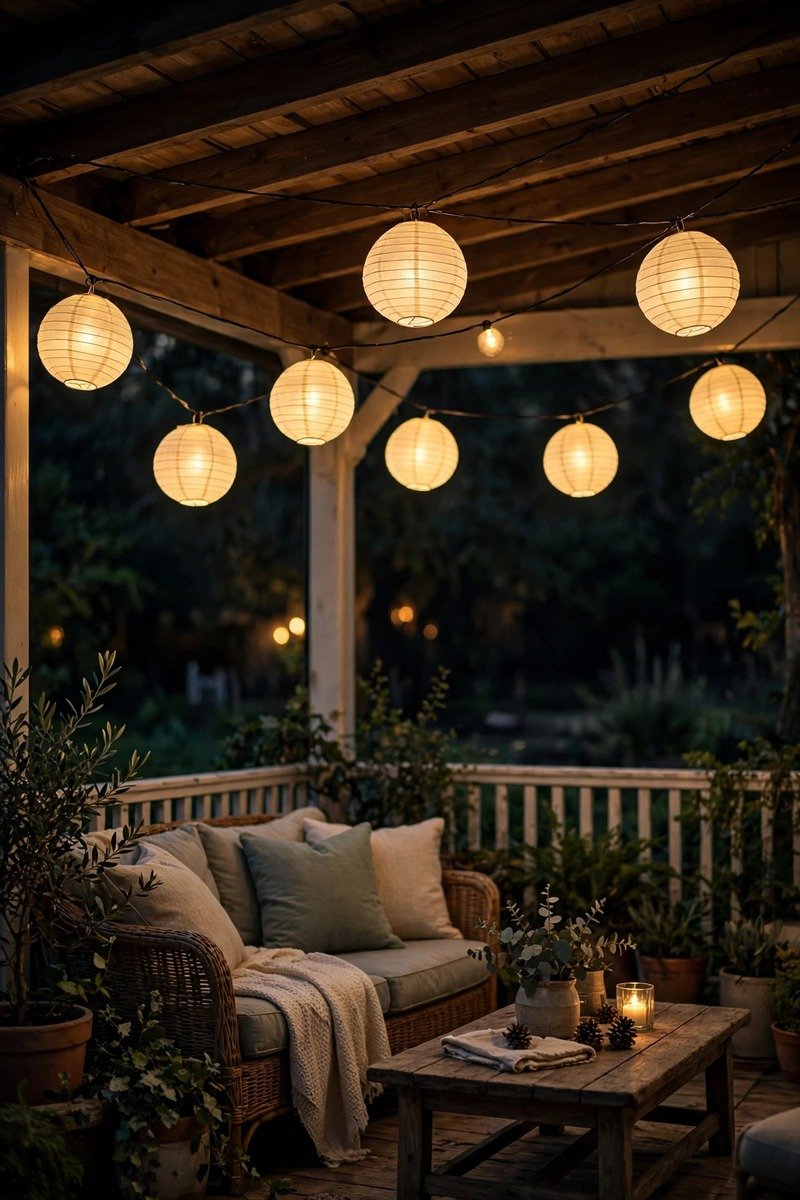
Paper shade strings soften direct bulbs and give a round, gentle glow. They suit covered porches best, since paper shades do not hold up well in heavy rain.
Pro tip: Bring paper lantern strands inside during storms. A 25 foot set costs about 20 to 40 dollars.
Power, Safety and Small Details
21. Solar Fence Line
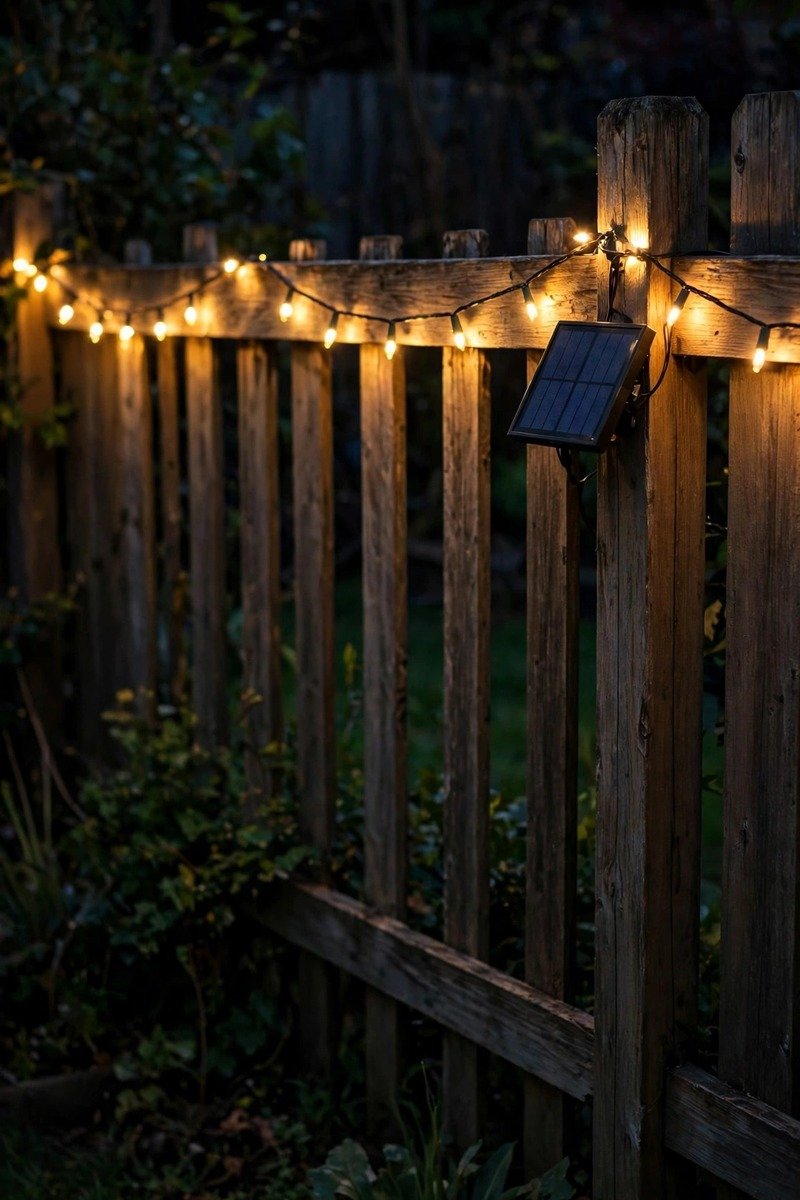
Solar strands are the easy choice for a fence far from an outlet. One strand along the top rail outlines the yard, and the panel charges in the day with no cord to run.
Pro tip: Pick a set with a separate panel on a long cord. Put the panel in full sun, even if the lights hang in shade, for 4 to 8 hours of night light.
22. Battery Strand for a Balcony
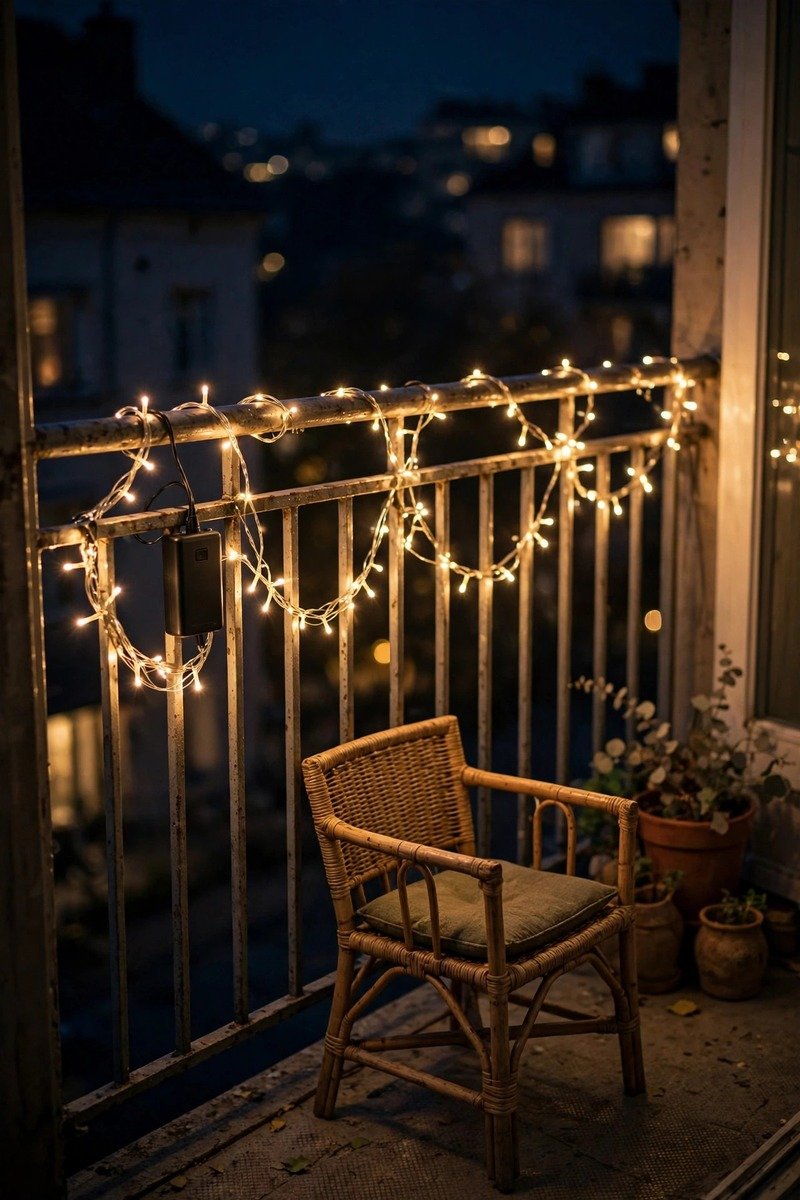
Battery strands need no outlet and no sun, which makes them ideal for a small balcony or a rental. A timer keeps them from draining fast, and the strand can move with you.
Pro tip: A battery strand costs about 15 to 30 dollars. Use rechargeable AA batteries and a 6 hour timer to stretch each charge.
23. Dining Chandelier Over a Long Table
Three strands bundled from one overhead point make a simple chandelier over a long table. The light stays centered, so plates and faces get light without a bright fixture overhead. For table styling to go with it, see our outdoor dinner party decor ideas.
Pro tip: Hang the bundle 30 to 36 inches above the table. Use a dimmer so the light can drop low once dinner starts.

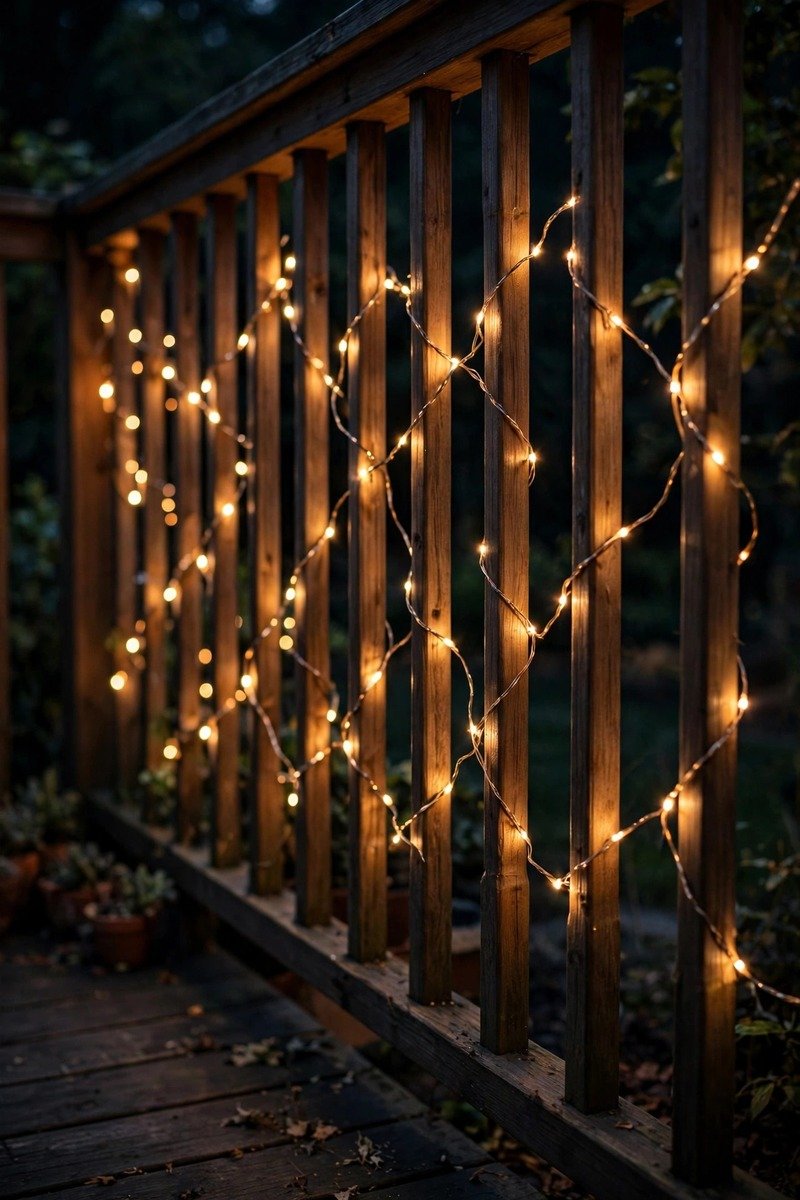
24. Railing Spindle Wrap
Weaving a thin fairy strand through railing spindles adds depth to a deck edge. The light shows between the bars instead of sitting in one straight line on top of the rail.
Pro tip: Use a flexible wire strand, not a thick cable strand. One 33 foot strand covers about 10 feet of railing.
25. Step Edge Lights
A low strand along step edges helps guests see where to walk after dark. It is one of the few string light ideas that does real safety work as well as looking good.
Pro tip: Use a low profile strand with small clips made for steps. Test the steps at night before guests arrive, and fix any dark gaps.

String Light Spacing by Span Length
Measure the span before you hang a single bulb. A span under 10 feet can hang straight between two points, with the bulbs about 12 inches apart, and the sag will be small. A span of 10 to 20 feet needs a slight sag, about 6 to 12 inches in the middle, so the weight does not pull the fixings out of the wall. A span over 20 feet needs a support wire, because a string that long pulls hard on both ends and sways in wind. Hang the wire first, then clip the lights to it every 2 feet, so the wire carries the weight and the lights carry only themselves. For outdoor string light ideas that last through winter, the support decides everything, because a string that sags too far snaps in the first ice storm.
Power for Winter Nights: Outlets, Timers and Load
Winter nights are long, so the power plan matters more than the bulbs. Use an outdoor outlet with a weatherproof cover, and plug into a GFCI outlet only, because a GFCI cuts the power in a fraction of a second if water gets in. Count the total watts before you plug in, and keep the load under 80 percent of the circuit, because a circuit that runs at full load trips on the coldest night. Use a timer, not a manual switch, and set the lights to come on at dusk and off at 10 pm, because a timer saves power and the lights are never left on all night. Use outdoor rated extension leads only, and keep every connection off the ground, at least 6 inches up, because a connection sitting in a puddle is a shock risk. As a typical range, an outdoor timer costs about 10 to 25 dollars, and a weatherproof extension lead costs about 15 to 30 dollars.
Wind, Ice and Rain: Keep Connections Dry and Safe
Winter weather attacks string lights at the connections, not at the bulbs. Wrap every plug connection in a weatherproof connection box, or tape it with outdoor electrical tape, because rain running down a string pools at the lowest plug. Make a drip loop in the cord before each connection, so water drips off the loop instead of running into the plug. Check the strings after the first hard frost, because ice adds weight, and a string that held in autumn can snap under a thin coat of ice. Bring in any string that is not rated for outdoor use, because indoor strings crack in cold and let water into the wiring. If a bulb breaks, replace it at once, because an open socket fills with water in one rain.
Budget for a Winter String Light Setup
Under 30 dollars: one 25 foot string of LED bulbs and an outdoor timer. From 30 to 100 dollars: add a second string, a support wire kit, and a set of spare bulbs. Over 100 dollars: add a third string, a weatherproof connection box set, and a dimmer for the whole run. As a typical range, a 25 foot LED string costs about 20 to 50 dollars, and a support wire kit costs about 15 to 30 dollars. Buy LED bulbs, because they use about a tenth of the power of old bulbs and they stay cool to the touch, so they are safer near dry winter leaves.
Common Mistakes to Avoid
- Buying indoor strands for outside. Indoor sockets fail fast in rain. Buy wet rated strands for exposed spots.
- Buying too little length. Measure the run, then add one third for droop and curves.
- Linking too many strands. Check the box limit. Too many linked strands can dim the far end or trip a breaker.
- Using cool white everywhere. Cool white can look harsh outdoors. Warm white near 2700K suits most yards.
- Hanging lights too low. Keep overhead lights 8 to 10 feet high so no one hits a bulb.
- Skipping the outlet check. Plug in lights need a GFCI outlet. If yours has no test button, ask an electrician first.